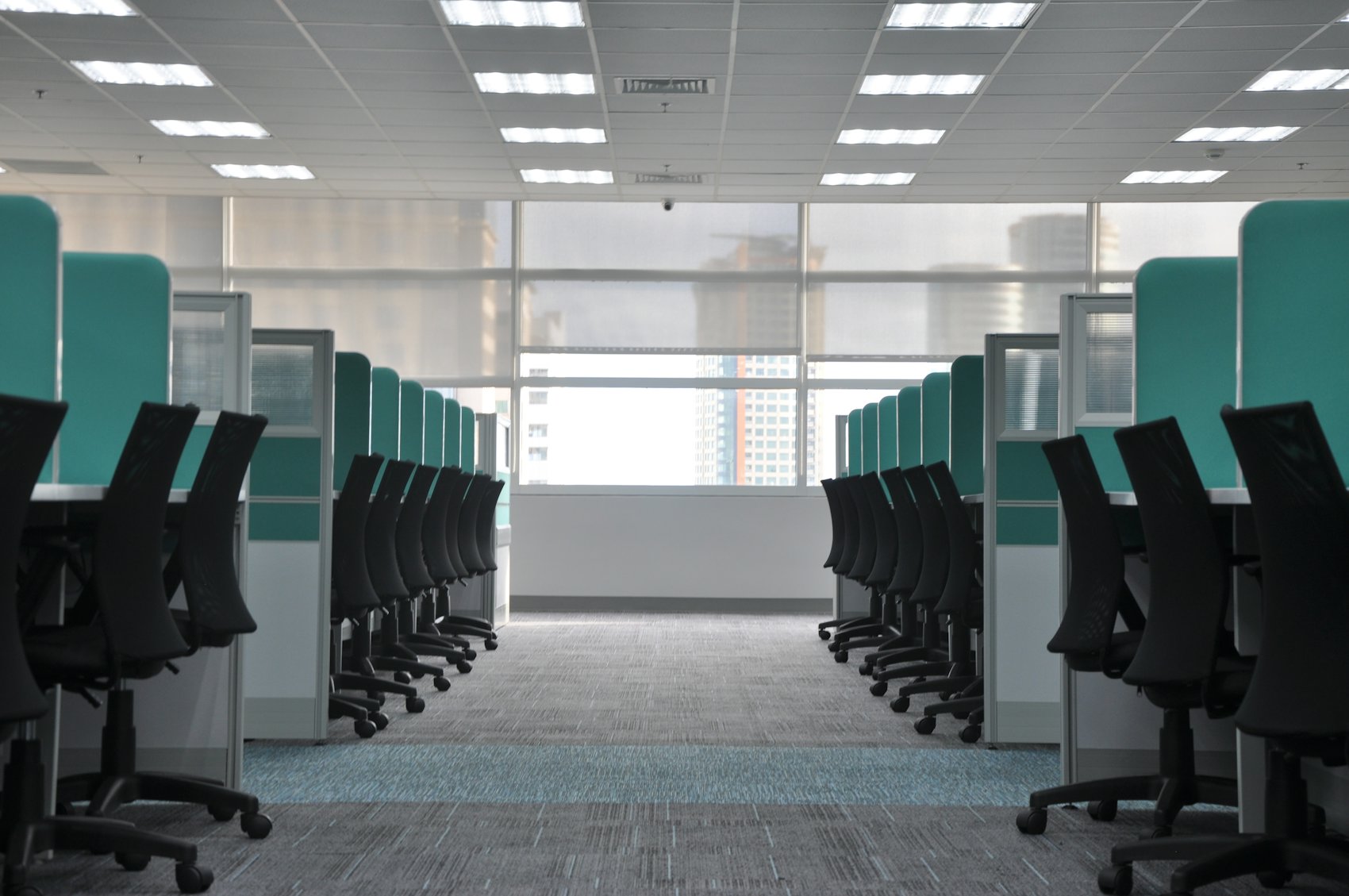
Short answer: A panel-hung workstation hangs its worksurface and storage on the cubicle panels: no desk legs, full knee space, power in the panel base and the most privacy. A freestanding (desk-based) workstation stands on its own legs or pedestals, with screens mounted on the desk and power from the floor or a shared spine: easier to move, reconfigure and reuse, but more open. Choose panel-hung for focus and phone-heavy roles, freestanding for teams that change often, and a hybrid of the two when you want both. Office Station plans and quotes all three, pre-owned, remanufactured or new, and space planning is free.
- How each build works
- Side-by-side comparison
- The tradeoffs that matter
- Buying pre-owned: why matching matters
- Hybrid builds: a panel spine with freestanding desks
- Which build fits your floor
How each build works
From across the room, a panel-hung cubicle and a desk with tall screens can look alike. Underneath, they are built on opposite principles: in one, the panels are the structure; in the other, the desk is.
Panel-hung: the panels carry everything
In a panel-hung (sometimes called panel-supported or panel-based) system, the fabric panels are not just walls. Each one is a steel frame with slotted uprights at its edges. The parts of the station attach to that frame:
- Worksurface. Cantilever brackets hook into the panel slots and the top sits on the brackets. There are no legs, so the area under the surface is open from panel to panel. Where a run ends without a panel, an end panel or a single support leg carries the open end.
- Power and data. A raceway in the panel base holds an electrical harness that passes from panel to panel through jumpers, with receptacles snapped in where each person sits. The whole run is fed from one point: a wall, a floor box or a ceiling power pole. Data cabling shares the raceway or runs at beltline height in panels that offer it.
- Storage and accessories. Overhead bins, shelves, task lights and tool rails hang on the same panel slots. Pedestals sit underneath, mobile or fixed.
- Connections. Panels join each other through two-way, three-way and four-way connectors, which is how pods of four or six share walls.
The result is rigid, quiet and tidy, with cords out of sight. The catch is that every component depends on the panels around it, so changing a station means working on the system, not just moving a desk.
Freestanding or desk-based: the desk carries itself
In a freestanding build, each worksurface is a desk in its own right. It stands on legs, a pair of end panels, a C-leg or T-leg frame, or a pedestal at one end. Everything else is added to the desk:
- Screens. Privacy and modesty screens clamp or bolt to the desk edge, typically fabric, laminate, glass or acrylic.
- Power and data. Cords run to floor boxes, a power pole, a power beam shared by a row of desks, or a low spine. Cable trays and spines under the surface keep the cords managed.
- Storage. Pedestals, lockers and storage towers stand on the floor beside or under the desk, rather than hanging overhead.
Benching systems are the most common freestanding format: long, shared frames with desks on both sides and a beam down the middle. Desking systems and modular casegoods are freestanding too, from L-shaped and U-shaped desks to private-office suites.
Side-by-side comparison
| Panel-hung workstation | Freestanding / desk-based | |
|---|---|---|
| What holds the worksurface | Brackets locked into the panel frame | The desk's own legs, end panels or pedestals |
| Legroom | Open from panel to panel, no legs to work around | Legs or frame members under the surface |
| Power | Harness in the panel base raceway, one feed per run | Floor boxes, power poles, a shared beam or a spine |
| Privacy | Full panels near the floor up to the chosen height, stackers available | Screens start at desk height, open below |
| Acoustics | Better, especially with taller fabric panels | Lighter, depends on screen height and material |
| Overhead storage | Hangs on panels | Usually floor-standing storage instead |
| Reconfiguration | System work, electrical changes often involved | Desks move and swap with less disruption |
| Move-out and reinstall | More parts to label, count and stage | Fewer parts per seat, simpler to stage |
| Pre-owned buying | Every part must match the line | More forgiving, desks and screens mix more easily |
| Sit-stand | Adjustable desk inside the panels, or a panel-mounted mechanism | Swap the base or desk for a height-adjustable one |
| Best fit | Focus work, phone-heavy roles, call centers, finance and HR | Collaborative teams, frequent change, hoteling and shared desks |
The tradeoffs that matter
Legroom and comfort
Panel-hung stations win on clear knee space. With no legs, a corner worksurface can be used along its full length, and a pedestal can roll to whichever side suits the person sitting there. Freestanding desks give up a little of that to their frame, which matters most on corner and U-shaped desks where legs land where knees want to go. Good desking lines minimize it with end panels or cantilevered frames.
Reconfiguration effort
Freestanding desks are the easy one to change. Facilities staff can usually slide, swap or add desks, re-clamp a screen and plug in at a power pole or beam. Changing a panel-hung station means unhooking the surface and overheads, reworking connectors and, when the run is powered, having an electrician reroute the harness or move the feed. Neither is hard for a crew that does it every week, but if your team reshuffles seating every quarter, the difference adds up. Our guide on reconfiguring spaces when teams change covers the planning side.
Move-out and reuse
When an office moves, a panel-hung floor comes apart as a kit: panels by height and width, connectors by type, brackets, trim, harness sections, base feeds, overheads, worksurfaces and pedestals. Each piece is labeled and staged so the same floor can go back together elsewhere. Lose the connectors or harness jumpers and the reinstall stalls. Freestanding desks come down with far fewer parts per seat, and each desk is complete on its own, which makes the move faster and the reinstall more forgiving.
How each holds value pre-owned
Complete, matched panel systems from established product lines have a long service life and a real reuse market, because their steel frames outlast their fabric and surfaces many times over. That is the basis of hybrid workstations: recycled panel cores with new trim, new surfaces and new fabric. The value depends heavily on completeness, though. An incomplete or mixed panel lot is worth much less than a complete one. Freestanding desks are simpler to resell one at a time, but plain desks are also easy to replace new, so condition and brand matter more than matching.
Acoustic and visual privacy
Fabric panels absorb sound and run close to the floor, so a panel-hung pod with 53-inch or 67-inch panels blocks far more conversation than a desk with a screen on top. Glass or fabric stackers add height while keeping daylight. Desk-mounted screens mostly block sightlines at seated eye level; voice travels under and around them. For call centers, recruiting, collections or anyone on the phone all day, panel-hung is usually the stronger build. If the floor is already open, our guide to creating a quieter office without renovation has other fixes.
Sit-stand
Freestanding desks handle sit-stand naturally: the base is replaced with an electric height-adjustable one, or the whole desk is. Panel-hung stations need a decision. The most common approach is to set a height-adjustable desk inside the panel footprint where the hung worksurface was, with clearance left to the panels so it can travel. Some panel lines also offer an adjustable mechanism that mounts to the panel frame. Either way, check that overheads do not clash with monitors at standing height and that cords have enough slack to travel with the desk. Lower panels or glass stackers often make a standing station feel less boxed in.
Buying pre-owned: why matching matters
Most buyers searching for used cubicle desks run into this difference without knowing it. A panel-hung system is a set of interlocking parts made to fit each other, and usually one product line or generation of it. Before a used panel-hung lot can be reinstalled, it has to be checked as a complete kit:
- Panels in the heights and widths the layout needs, with matching frames.
- Connectors for every two-way, three-way and four-way joint, plus end-of-run trim.
- Brackets that fit the panel slots and the worksurface depth.
- Electrical: base raceways, harnesses, jumpers, receptacles and base, wall or ceiling feeds from the same system.
- Worksurfaces, overheads and pedestals sized to the panel widths.
One missing connector type or a harness from a different line can hold up a whole run. That is why inventory is counted by component when a floor is taken down, and why a station count alone does not tell you whether a used lot will build your layout.
Freestanding desks are more forgiving. Each desk is complete, screens clamp to almost any desk edge, and power comes from separate poles or floor boxes. Mixed sources can still look uniform if the laminate and frame colors are close.
When a used panel lot has the right cores but tired fabric, worn surfaces or missing trim, remanufacturing or a hybrid rebuild brings it back to an as-new finish. Browse used and remanufactured cubicles, or compare the grades in the used vs remanufactured vs new cubicles guide.
Hybrid builds: a panel spine with freestanding desks
Many floors end up somewhere in the middle. A common hybrid runs a short powered panel spine, often 42 to 53 inches high, down the center of a row. Freestanding desks butt up to it from both sides. The spine carries power and data, adds privacy between facing neighbors and can hold a tool rail or a shelf. The desks stay independent, so they can be moved, swapped for sit-stand or reconfigured without touching the spine's electrical.
Other mixes work too: panel-hung pods for phone-heavy teams beside benching for collaborative ones, or freestanding desks in private offices with a panel system on the open floor. Modular desks and panel runs can be planned together on one drawing so the aisles, power feeds and finishes line up.
Which build fits your floor
| If your floor needs... | Lean toward |
|---|---|
| Quiet focus, phone work, confidential calls | Panel-hung, with 53-inch or 67-inch panels |
| Frequent seating changes, hoteling, shared desks | Freestanding desking or benching |
| Hidden cords and one power feed per run | Panel-hung with a powered base |
| Sit-stand on every seat | Freestanding, or adjustable desks inside panels |
| Some privacy and easy moves | Hybrid: panel spine with freestanding desks |
| A tight schedule on a pre-owned budget | Whichever matched inventory fits the layout, or a hybrid rebuild |
Floor conditions decide a lot too: where the columns, windows and existing floor boxes sit, whether power has to come down from the ceiling, and how many seats the plan must hold. The cubicle configurations guide shows rows, pods, spines and L- and U-shape layouts, and the free space plan places your choice around the real floor.
To compare both builds for your space, send a floor plan, a headcount or even a phone sketch through the form below, email hello@officestation.com, or call 602-703-4000 and ask for Tony. Space planning is free, and every project is quoted individually.
Related planning resources
More on cubicle and workstation buying guides:
- Enclosed Cubicles With Doors: High-Wall Private Workstations
- ADA-Accessible Cubicles: Planning Workstations Everyone Can Use
- Modular Office Walls vs Cubicles: When You Need a Wall and When Panels Will Do
- Buying a Used Cubicle Lot From Another City: Freight, Install and What to Verify
- Used Cubicles From West Michigan: Buying Where Steelcase, Herman Miller and Haworth Are Made
All of Office Station's planning guides and local service pages are collected on office furniture resources.
Frequently asked questions
What is a panel-hung workstation?
A panel-hung workstation is a cubicle whose worksurface has no legs of its own. The surface is carried by cantilever brackets that lock into slots in the steel frame of the panels around it, and overhead storage hangs from the same panels. Power and data usually run through a raceway in the base of the panels, fed from a wall, floor or ceiling connection.
What is a freestanding or desk-based workstation?
A freestanding workstation is a desk that stands on its own legs, end panels or pedestals. Privacy screens clamp or bolt onto the desk rather than standing on the floor, and power comes from floor boxes, power poles or a shared beam or spine. Benching and desking systems are freestanding builds.
Which is better for privacy, panel-hung or freestanding?
Panel-hung stations usually give more acoustic and visual privacy, because full fabric panels run from near the floor to the chosen height and can be topped with glass or fabric stackers. Desk-mounted screens on freestanding desks start at the worksurface and leave the space below open, so they cut sightlines more than they cut sound.
Can a panel-hung cubicle be made sit-stand?
Yes, in two common ways. A height-adjustable freestanding desk can be set inside the panel footprint in place of the hung worksurface, or some panel lines offer an adjustable worksurface mechanism that mounts to the panels. Panel height, overhead storage and monitor clearance all need checking at full standing height, which is part of the free space plan.
Why does a used panel-hung lot need every part matched?
Panels, connectors, brackets, trim and electrical harnesses are made to fit one product line, and often one generation of it. A missing connector, a bracket from a different line or a harness that does not match the base raceway can stop a run from going together. Freestanding desks carry their own structure, so a desk from one source and a screen from another usually still work.
Can panel systems and freestanding desks be combined?
Yes. A common hybrid build uses a short powered panel spine down the middle of a run, with freestanding desks pushed up to it on both sides. The spine carries power, data and privacy, and the desks stay simple to move and swap. It suits teams that want some separation without a full cubicle on every seat.