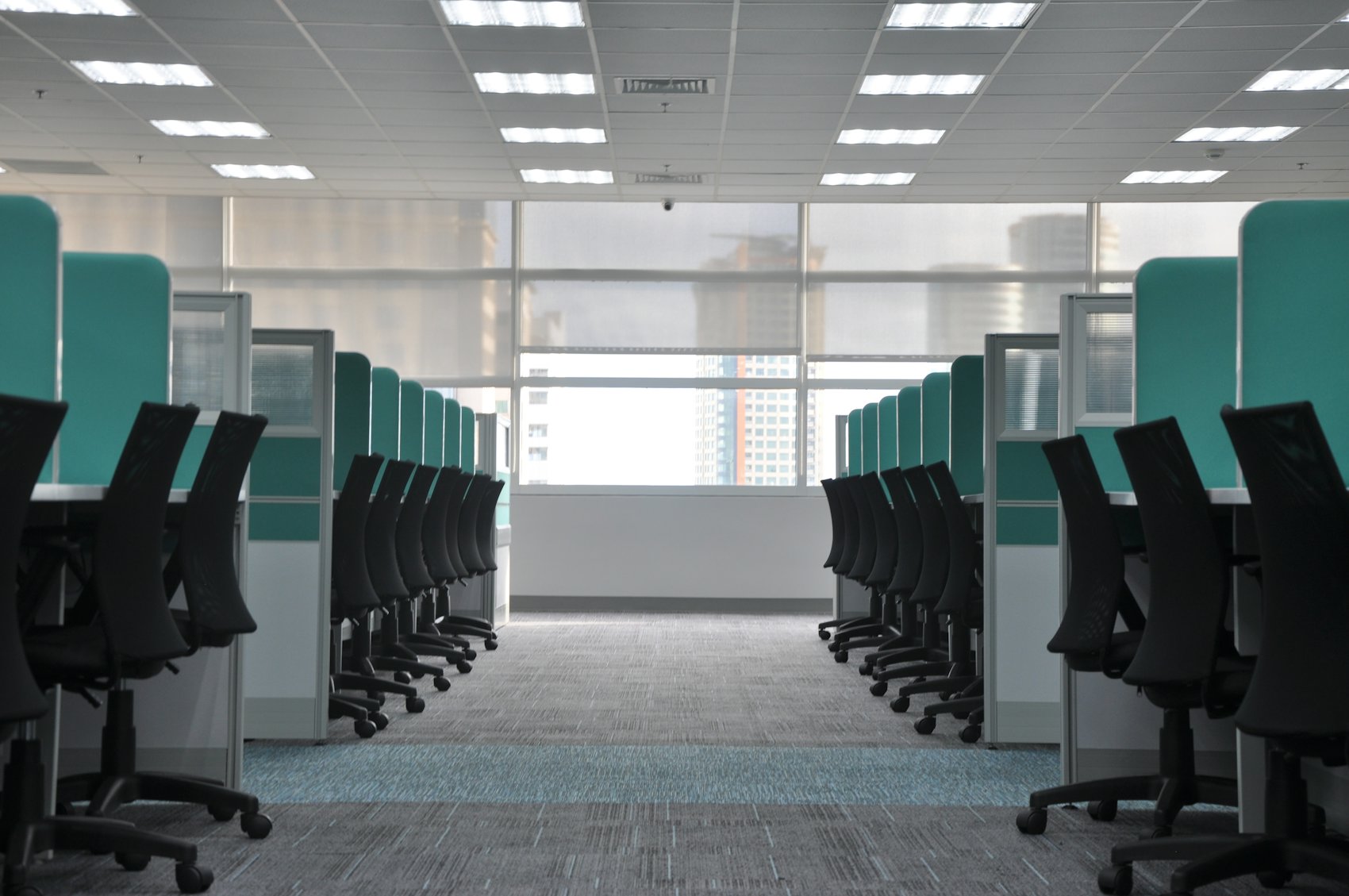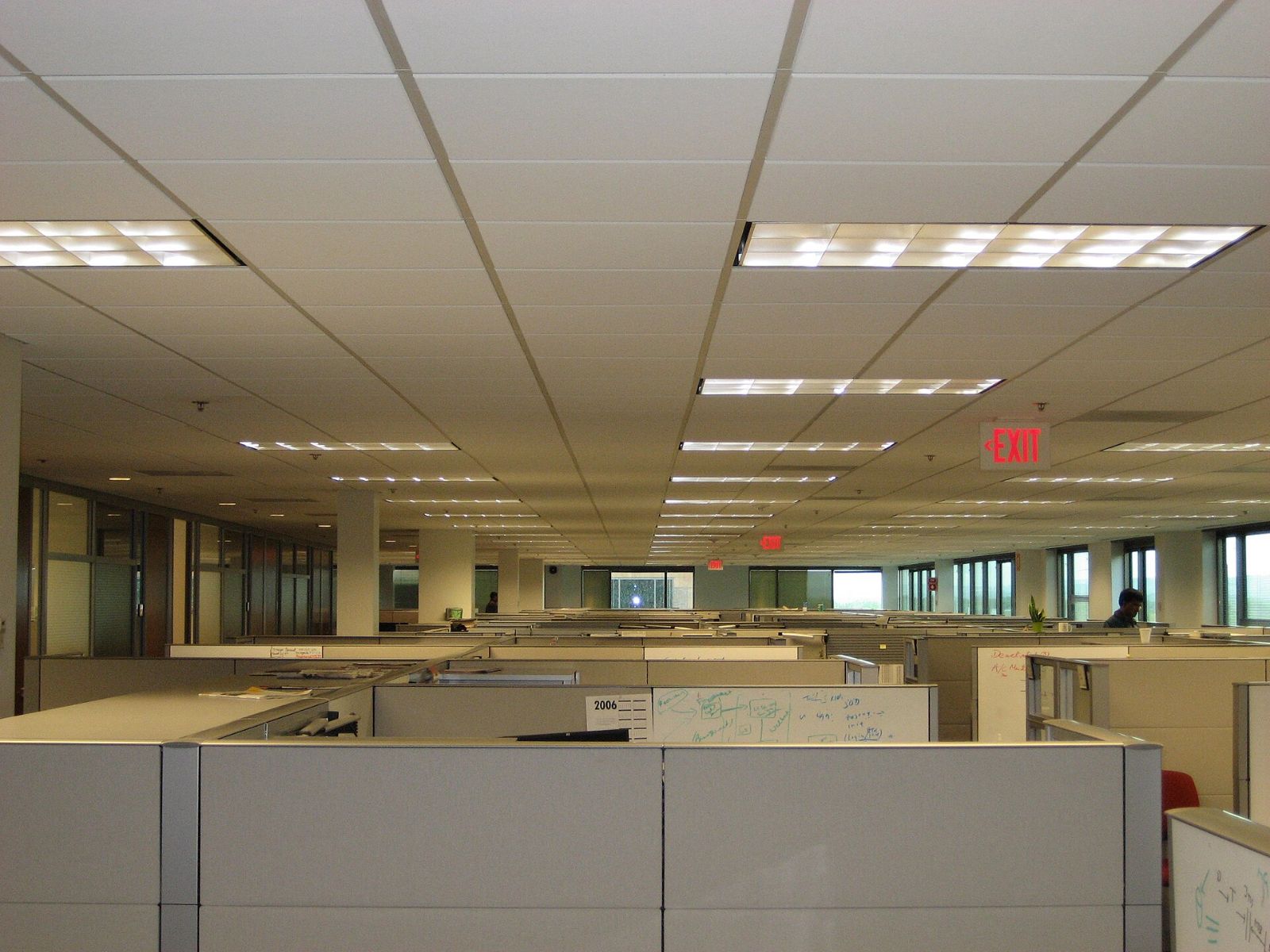
A call center is not a regular office with more desks. Agents spend the day on a headset, supervisors need to see the whole room at a glance, and every extra seat per square foot changes the economics of the lease. Call center cubicles are built around those facts: compact footprints, low panels and long repeatable rows. This page covers how to lay them out, what they cost at scale and what to check before a 50 or 100 seat order.
What makes a good call center station
- Compact footprint. Enough surface for screens, a keyboard and a headset, without the large corner surface a knowledge worker needs.
- Low panels. Supervisors can scan the floor, and agents can raise a hand for help without leaving the seat.
- Acoustic fabric. Low does not mean bare. Fabric-wrapped panels soften voice carryover between neighbors.
- Power and data in the run. Every seat needs reliable connections, so powered panels or a clear cable path matter more here than anywhere else.
- Repeatable rows. Identical stations make installation faster, reconfiguration simpler and spare parts interchangeable.
Common high-density layouts
Back-to-back rows
Two rows share a spine panel, often slightly taller than the side panels. This is the most efficient use of floor area and simplifies power distribution along the spine.
Pods of four or six
Stations cluster around a shared center, which keeps teams together and gives each supervisor a defined group. Pods use more floor than straight rows but improve team coaching.
Benching-style runs
Long shared runs with short dividers between seats offer the highest density. They work best when agents do not need personal storage at the station.
Whichever layout you choose, plan aisle widths for real traffic. Shift changes move many people through the same aisles at once, and your local code sets the minimums. Office Station provides free space planning, so you can compare seat counts for each layout on your actual floor plan.
What volume pricing does at 50 and 100 seats
Call center cubicles are usually quoted per project because station sizes vary. To show the effect of volume pricing, the table below uses Office Station's published 6'x6' furniture-only prices as a reference. A compact agent station will price differently, but the discount tiers work the same way.
| Seats | Discount | Liquidation-grade ($615 each) | Remanufactured ($1,245 each) | Installation at $95 each |
|---|---|---|---|---|
| 20 | 5% | $11,685 | $23,655 | $1,900 |
| 50 | 8% | $28,290 | $57,270 | $4,750 |
| 100 | 12% | $54,120 | $109,560 | $9,500 |
Average market rate Prices subject to availability and project pricing.
At 100 remanufactured reference stations, the 12 percent discount is worth $14,940, which more than covers the $9,500 to install the floor. Furniture prices exclude electrical and delivery. Greater Phoenix delivery is $195 central or $295 metro, and freight elsewhere in the country is quoted per project.
Choosing a tier by opening date
| Your timeline | Tier to consider | Lead time |
|---|---|---|
| Opening within days | Liquidation-grade | As little as 72 hours, in stock |
| Opening in two to three weeks | Remanufactured | Usually 7 to 14 days |
| Opening in six weeks or more | New | 4 to 6 weeks |
For large seat counts, the limiting factor with pre-owned stock is having enough matching stations at once. The earlier you share your seat count, the better your options.
Pre-order checklist for call center cubicles
- Final seat count, plus spare stations for growth or trainees.
- Floor plan showing columns, exits, restrooms, break areas and power and data entry points.
- Monitor count per agent and whether screens mount to arms or sit on the surface.
- Panel height for side, spine and aisle-facing panels.
- Supervisor stations, which often go in a larger footprint such as an 8x8 cubicle at the end of rows.
- Electrician scheduled for powered panel connections.
- Condition grade across the order: A like new, B very good or C good.
- Seating. Agents sit all shift, so budget for pre-owned office chairs that fit your people.
Adding seats to an existing floor
If you already run a call center and need more seats, you may not need complete stations. Adding pre-owned panels and dividers that match your system can extend existing rows. And if you are consolidating centers, Office Station provides office furniture liquidation with a written net offer for the furniture you no longer need.
Planning installation day
A large floor goes in faster when the room is ready. Before installers arrive, make sure:
- The floor is clear and carpet or flooring work is finished.
- Your building has confirmed elevator and dock access for the delivery window.
- Power and data locations are finalized, so powered runs start in the right places.
- Someone on site can answer layout questions and sign off on each row.
Installing row by row also lets you open part of the floor early if training classes start before the full build is finished.
Frequently asked questions
What size are call center cubicles?
Call center stations are usually smaller than standard office cubicles because agents work mainly on a headset and one or two screens. Compact footprints with short work surfaces are common. The right size depends on your screens, whether agents keep paper or personal storage, and your local code requirements for aisles.
What panel height works best for a call center?
Many call centers use low panels, roughly seated eye level or a bit higher, so supervisors can see the floor and agents can signal for help. Panels still need enough height and fabric to cut down on voice carryover between neighbors. Some floors use taller panels only between back-to-back rows.
How does volume pricing work for call center cubicles?
Office Station applies volume pricing of 5% at 20 or more stations, 8% at 50 or more and 12% at 100 or more. Your written quote shows exactly how it applies. On a 100-seat floor, that discount can be worth more than the installation cost.
How fast can a call center be furnished?
Liquidation-grade stations can ship in as little as 72 hours when enough matching stock is on hand. Remanufactured stations usually take 7 to 14 days and new stations take 4 to 6 weeks. Large seat counts depend on available matching inventory, so ask early.
Is installation included for large orders?
No. Installation is $95 per workstation with a $495 minimum, so a 100-seat floor is $9,500 to install. Electrical and delivery are also separate, with Greater Phoenix delivery at $195 central or $295 metro and freight quoted elsewhere.
Average market rate Prices subject to availability and project pricing.