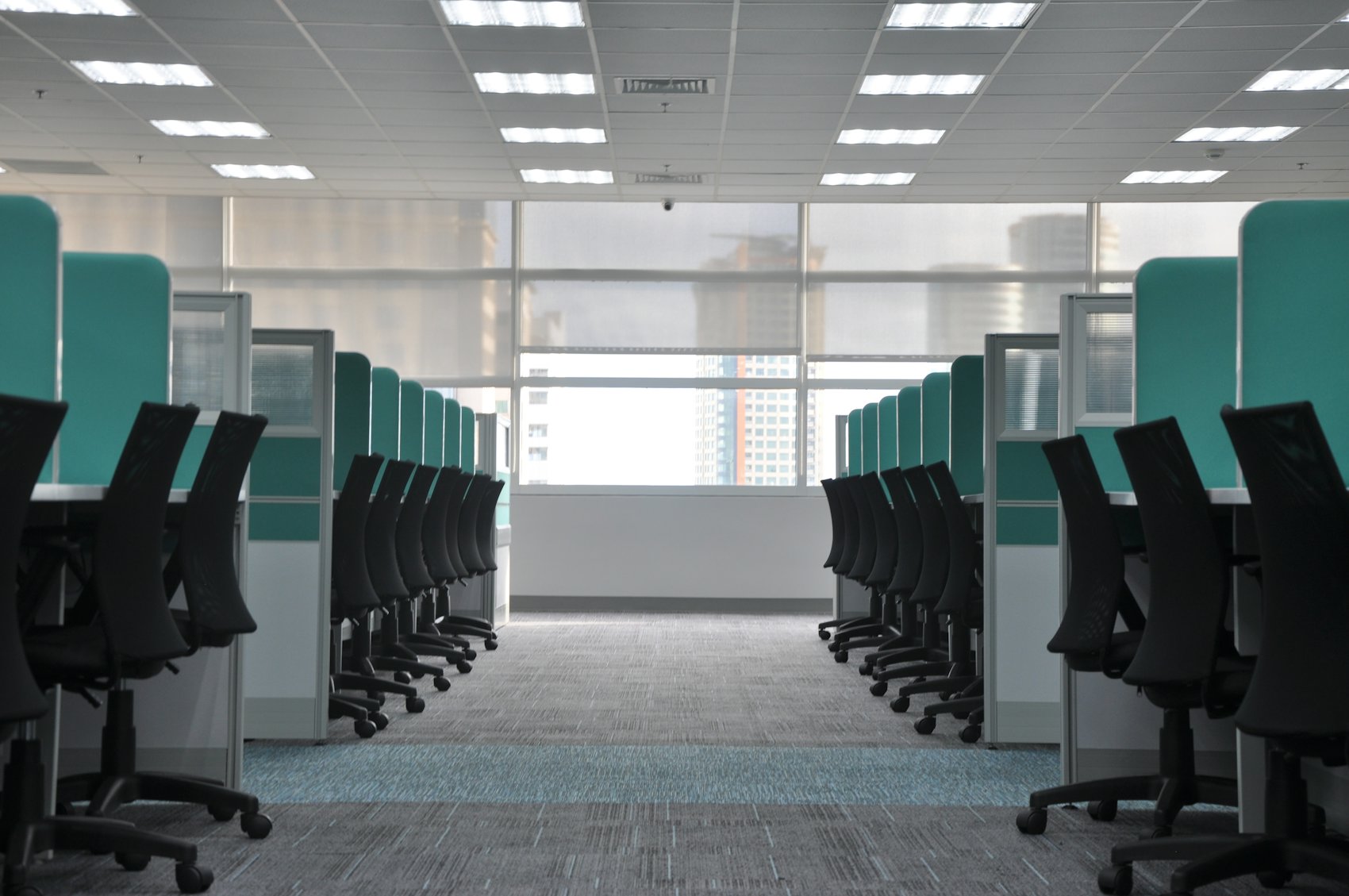
Buying pre-owned is a budget decision, not a design decision. The two get confused because most people have only seen pre-owned furniture sold with whatever finishes it wore out of the last building. A well-specified pre-owned floor can look better than a cheaply specified new one, because the frames underneath came from premium systems nobody buys new at entry-level budgets. Here is what dates a cubicle, what each fix costs, and how to specify a floor that photographs well.
- What actually dates a cubicle
- What it costs to fix each one
- Remanufacturing as a design tool
- Mixing panel heights so the floor reads intentional
- Glass stack-ons and where they earn their cost
- How to specify a floor that photographs well
- The honest limits
- The numbers, side by side
What actually dates a cubicle
Walk into an office that looks like 1998 and list what you are reacting to. It is almost never the steel. It is six surface decisions, and they compound.
Panel height
Nothing dates a floor faster than 65-inch and taller panels wall to wall. Tall panels were the point of the 1990s cubicle: maximum separation, maximum storage hung off them. The current default is a 53-inch mid panel, which still separates a seated person but lets you see across the room. A uniform 65-inch floor reads as a call center no matter what fabric you put on it.
Fabric color and texture
Saturated mid-gray, teal, mauve and speckled tweeds are the tells, and so is heavy texture. Current panel fabrics run lighter and quieter: warm gray, greige, oatmeal, soft charcoal, with a flat or finely woven face. Saturation matters more than hue. A muted fabric recedes and lets the worksurfaces and chairs carry the room.
Worksurface edge profile
Invisible until you notice it, then you cannot stop noticing it. A thick black bullnose edge, especially a contrasting one on a light laminate, is the most reliable 1990s marker in an office. Current worksurfaces use a thin edge band matched to the top, so the surface reads as one piece.
Laminate tone
Orange-toned woodgrains date badly. Cherry, light oak and honey maple were everywhere for fifteen years and now they read as their decade. Current tones go neutral-warm or cool: urban walnut, espresso, white, light gray woodgrain. A white or pale gray top also makes a small station feel bigger, which matters on a 6' x 6'.
Frame and leg finish
Beige, putty and light gray painted steel are the giveaway on trim, legs and connectors. Black, graphite and soft white read current. Matching every exposed metal element to one of those three pulls the whole floor forward.
Cable management
A power strip hanging off a panel with cords draped over the worksurface undoes every other decision you made. Systems furniture has always had base raceways and panel-top channels. Using them, and putting grommets where monitors actually sit, is a design decision as much as an electrical one.
What it costs to fix each one
Every item above sits on a different point of the cost curve, and some are close to free.
| What dates it | How hard to change | Where the cost lands |
|---|---|---|
| Panel height | Easy if you are buying, harder after install | Priced as a multiplier: 42" x 0.95, 53" x 1.00, 65" x 1.08. Going shorter is cheaper. |
| Panel fabric | Standard remanufacturing work | Included in the remanufactured grade. Can be done selectively on liquidation stock, quoted per project. |
| Worksurface laminate | Standard remanufacturing work | Included in the remanufactured grade. New tops are a common selective upgrade on liquidation stock. |
| Edge banding | Replaced with the worksurface | Effectively free once you are replacing the top. |
| Frame and trim finish | Repaint or powder coat | Included in the remanufactured grade where needed. |
| Cable management | Specification, not furniture | Costs planning time, not money. Free space planning covers it. |
| Glass stack-ons | Only if the system accepts them | An add, quoted per project. Worth it on some panels, not most. |
The pattern: the things that date a cubicle most are the things that cost least to change, because they are wear items a real remanufacturing process replaces anyway. The expensive parts of a workstation are the steel frames and panel structure, and neither is what makes a floor look old.
Remanufacturing as a design tool
Most buyers think of remanufacturing as a repair process. It is more useful to think of it as a specification process that happens to cost less than buying new.
A remanufactured station starts as a used premium system. The frames get reused and refinished. Then you choose: new panel fabric from a current range, new worksurfaces in a current laminate tone, new edge banding matched to the top, new frame finish. Those are the same four decisions a designer makes when specifying new furniture, made on a better frame than your budget would buy new.
That is the argument in one line. At $1,245 for a 6' x 6' remanufactured station against $1,920 new, you are not choosing between a nice floor and a cheap floor. You are choosing between a premium frame with current finishes and an entry-level new frame with current finishes, and the premium frame usually wins on panel rigidity, worksurface thickness and hardware. Our used vs remanufactured vs new comparison breaks down what gets replaced at each grade. Remanufactured stations run 7 to 14 days, so this is a plan-ahead decision, not a lease-emergency one.
Where liquidation grade still makes sense
At $615 for a 6' x 6', liquidation grade is the cheapest way to fill a floor, and it does not have to look it. The move is selective refresh: leave the frames and panels as they came and replace only the surfaces that carry the room. New worksurfaces in a current laminate with a matched thin edge band, on stations whose fabric is already a neutral, gets you most of the way for a fraction of the remanufactured delta. It depends on what is in stock, so ask before you plan around it. Liquidation stations install in as little as 72 hours.
Mixing panel heights so the floor reads intentional
A single panel height everywhere makes a floor look like a grid. Varying it makes it look planned. Height should follow function, and the variation should be legible from the door.
- 42-inch low panels for team pods and collaborative roles. Seated people can see each other and the floor feels open.
- 53-inch mid panels as the default for focused individual work. Seated privacy, standing sightlines.
- 65-inch tall panels used deliberately: managers, HR, finance, anyone on sensitive calls, and as a screen against a noisy corridor or breakroom.
Step heights at the edge of a pod, not randomly mid-run, and keep each pod internally consistent. Three heights arranged by function reads as a plan; the same three scattered reads as leftover inventory. Our layout picker shows how single stations, 2-packs, inline runs, clusters, bullpens and benching arrange on a real floor plate.
The pricing helps. Because 42-inch panels price at 0.95 and 65-inch at 1.08, a floor that runs low panels where it can and tall panels only where it must lands close to a flat 53-inch floor in total cost while looking considerably better.
Glass stack-ons and where they earn their cost
A glass or acrylic stack-on is a clear segment that sits on top of a fabric panel, adding height without blocking light. It is the most effective single way to make a cubicle floor look current, and the most commonly over-specified item on a quote.
It earns its cost in three places: on panels facing a window wall, where blocking daylight would darken the interior of the floor; on panels facing a main aisle or a client path, because that is what visitors see; and where you need a 53-inch panel to function like a 65-inch one without closing the room in.
It does not earn its cost on interior panels between two people who already share a pod, on panels facing a wall, or as a uniform treatment across a whole floor, which reads as a fishbowl and costs real money. Spec glass on 15 to 25 percent of panels and the floor looks designed. Spec it everywhere and it looks like a budget got away from someone. Not every panel system accepts stack-ons, so confirm compatibility before it lands in a design.
How to specify a floor that photographs well
If the office is going on a careers page or a listing, the photograph is the deliverable. A few decisions carry most of it.
- Pick one laminate tone and hold it. Mixed woodgrains photograph as clutter. One tone everywhere, private offices included.
- Keep panel fabric lower in contrast than the worksurface. The eye should land on the desks and the people, not a wall of color.
- Match every exposed metal. Legs, trim, connectors, end caps, monitor arms, chair bases. Black or graphite is the safe choice and it is what most pre-owned seating already is.
- Lower the panels at the entry point. The sightline from the door is the shot. Put your 42-inch and 53-inch runs there.
- Solve cable before install day. Grommets where monitors sit, power through the base raceway, no surface strips. This is the difference between a clean photo and a retouching job.
- Match the seating. Mismatched chairs undo a matched floor of panels. All of our pre-owned seating is photographed in black for that reason.
The honest limits
Some things you cannot change cheaply, and you should know them before you sign.
- Panel thickness and profile. Both are fixed by the system. If the frame reads bulky, new fabric will not make it slim.
- Worksurface shape. Curved corners and the deep peninsula returns common in older plans can sometimes be swapped, but not always, and it depends on inventory.
- Built-in overhead bins. You can remove them, but the panel will show the mounting rail and storage has to go somewhere else.
- Power and data. Older powered panels may not carry the circuit count a current office needs. Electrical is quoted separately in every case.
- Warranty. Manufacturer warranties generally do not transfer to pre-owned furniture, at any grade. Get whatever coverage you are offered in writing.
- Exact quantity matching. Pre-owned inventory is finite. A 40-station floor in one fabric and one laminate is routine; 300 stations in a specific combination has to be planned around what exists.
Office Station is an independent reseller, not an authorized dealer. Brand names identify the original maker of the furniture, nothing more.
The numbers, side by side
Furniture only, per workstation. Electrical, delivery and professional installation are quoted separately.
| Station | Liquidation grade | Remanufactured | New |
|---|---|---|---|
| 6' x 6' | $615 | $1,245 | $1,920 |
| 6' x 8' | $725 | $1,410 | $2,170 |
| 8' x 8' manager | $850 | $1,615 | $2,470 |
| Open bench seat | $460 | $875 | $1,235 |
| Lead time | As little as 72 hours | 7-14 days | 4-6 weeks |
Average market rate Prices subject to availability and project pricing.
Apply the panel-height multiplier on top: low 0.95, mid 1.00, tall 1.08. A remanufactured 6' x 6' on low panels is about $1,183; on tall panels, about $1,345. Across a 40-station floor, running low panels in the collaborative zone pays for the glass stack-ons at the entry. Price your own mix in the instant quote builder, or browse pre-owned office furniture.
Space planning is free. Send a floor plan, a station count and a rough budget to hello@officestation.com and we will come back with a layout, a finish direction, and the same project priced at more than one grade so you can see the trade-off in dollars instead of adjectives.
Frequently asked questions
Do used cubicles look outdated?
Some do. What dates them is almost always surface: tall gray fabric panels, dark bullnose worksurface edges, cherry or oak laminate and beige frames. None of that is structural. Liquidation-grade stations at $615 for a 6' x 6' arrive with their original finishes. Remanufactured stations at $1,245 arrive with new fabric, new laminate and refinished frames in current colors.
What makes a cubicle look old?
Five things, in order of impact: panel height above 65 inches, saturated or speckled fabric in gray, teal or mauve, a thick contrasting bullnose edge on the worksurface, warm orange-toned laminate like cherry or light oak, and exposed cable coming off the worksurface. Fix the first four and most people cannot tell the age of the frame underneath.
Can you change the fabric color on used cubicles?
Yes. Panel tiles and fabric are wear items and get replaced during remanufacturing, so you pick from current fabric ranges rather than inheriting the previous tenant's color. You can also refabric selectively, doing the panels that face circulation and leaving interior panels alone. Ask for the project quoted both ways before you decide.
Are remanufactured cubicles as attractive as new ones?
On the surfaces people see and touch, yes. Fabric, laminate, edge banding and frame finish are all new, and they are specified from current color ranges. What you do not get is the newest structural design details or a manufacturer's new-product warranty. A 6' x 6' remanufactured station runs $1,245 against $1,920 new, furniture only.
What panel height looks most modern?
A 53-inch mid panel is the current default. It gives a seated person real separation while keeping sightlines open across the floor. Office Station prices panel height as a multiplier: low 42 inches at 0.95, mid 53 inches at 1.00, tall 65 inches at 1.08. Going shorter costs slightly less, not more.
Can you add glass to existing cubicle panels?
Often, yes, if the panel system accepts stack-on segments. A glass or acrylic stack-on adds height for privacy without blocking light, which is why it is worth paying for on the panels that face a window wall or a main aisle. It rarely earns its cost on interior panels nobody looks past. Free space planning will show you where it matters.
Average market rate Prices subject to availability and project pricing.