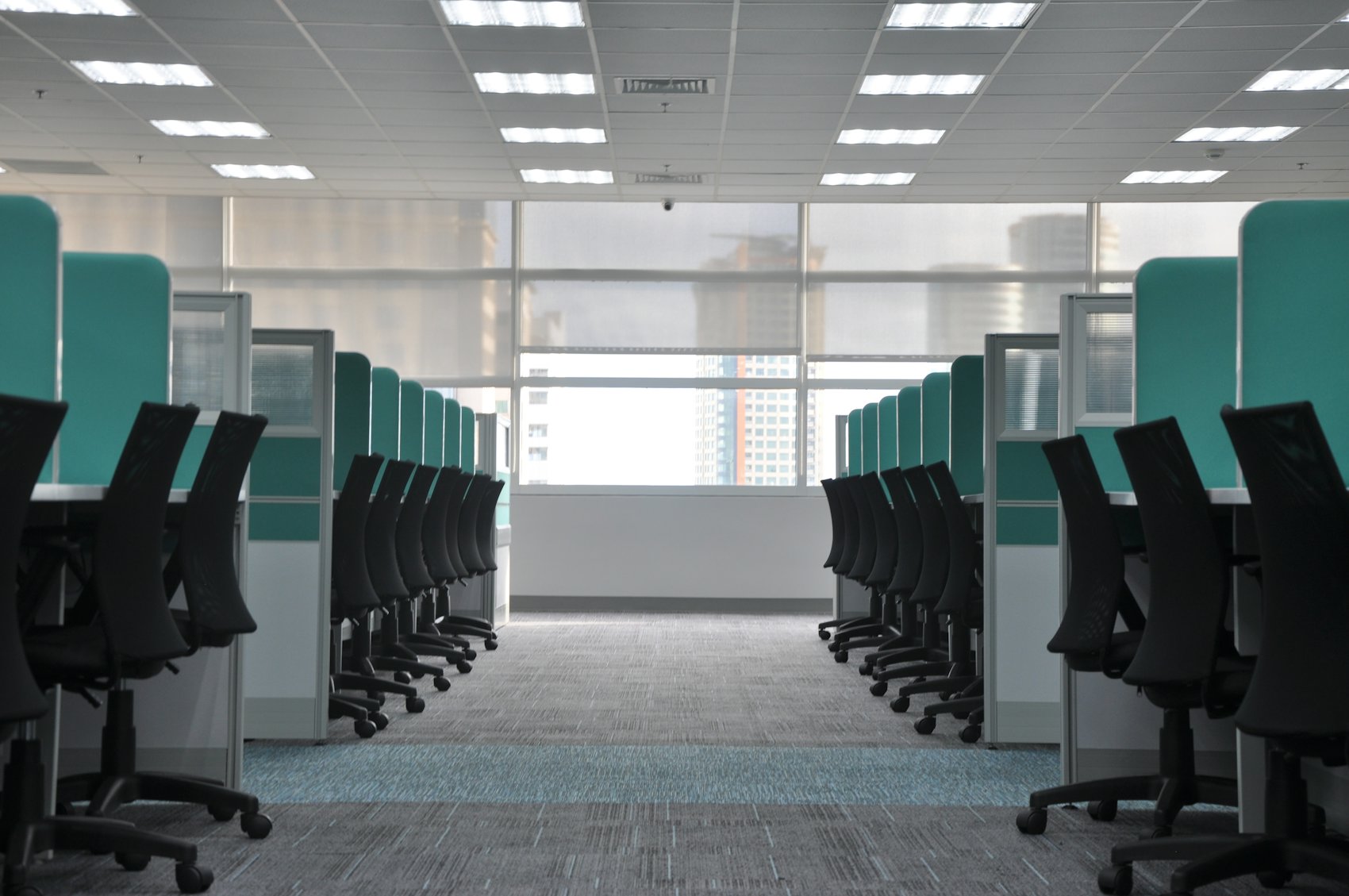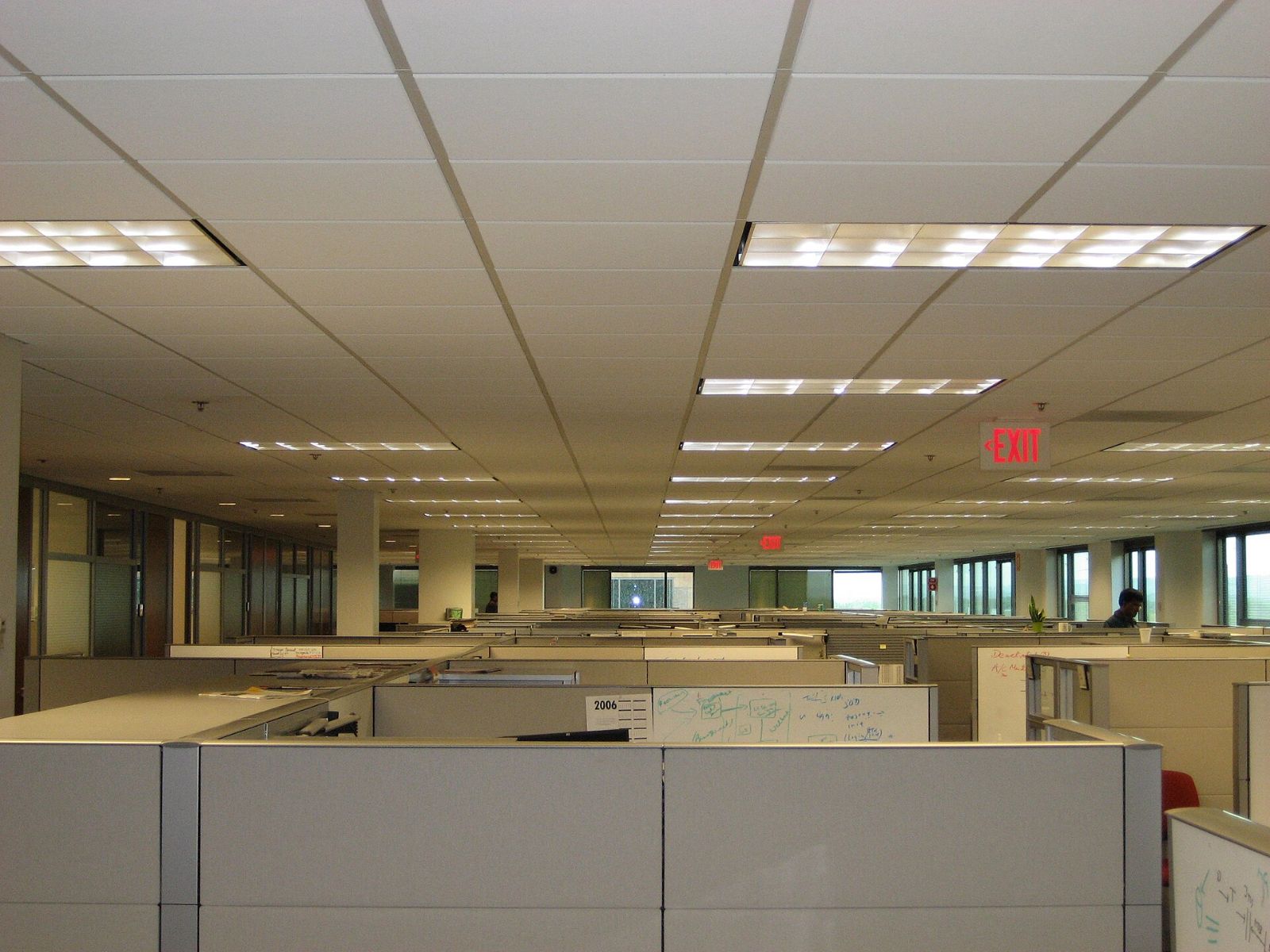
If your office has cubicles, it almost certainly has a panel system. Panel system office furniture is a kit of connected wall panels that hold up worksurfaces, storage and power. The panels do the structural work, which is why a floor of stations can be taken apart, resized and put back together in a new layout. That flexibility is the whole reason panel systems have outlasted every trend in office design.
How a panel system is built
Every line is a little different, but the core parts are consistent.
- Panels: the vertical frames, usually fabric, laminate, glass or a mix. Stacking or segmented panels let you change height and finish in layers.
- Connectors: hardware that joins panels in straight runs, L corners, T junctions and X junctions.
- Worksurfaces: rectangular, corner and extended surfaces that hang from slotted standards or brackets on the panels.
- Storage: overhead bins and shelves hung on the panels, plus pedestals and lateral files on the floor.
- Power and data: base raceways that carry electrical harnesses and cable through the panel bottoms, fed from a wall or a ceiling pole.
- Finishing parts: end caps, trim, toppers and glass that give the finished look.
Monolithic versus stackable
Older and simpler systems use monolithic panels: one piece per height, one fabric per panel. Stackable or tiled systems build a panel from segments, so you can add glass at the top, a marker board in the middle or lower the whole wall later without replacing the frame. Stackable systems cost more but reconfigure far more easily.
Panel height
Heights set the feel of the floor. Low panels around 42 inches keep sightlines open and suit collaborative teams. Mid heights in the 53 to 55 inch range give seated privacy while standing people can still see across. Tall panels of 65 inches and up are for focused work, call-heavy roles and teams that need sound control.
Per-station pricing by grade
Most panel system projects are priced per station. Here is a standard 6'x6' workstation, furniture only, across the three grades Office Station supplies.
| Grade | 6'x6' station, furniture only | 20 stations | Typical lead time |
|---|---|---|---|
| Liquidation-grade | $615 | $12,300 list, $11,685 after 5% volume | As little as 72 hours in stock |
| Remanufactured | $1,245 | $24,900 list, $23,655 after 5% volume | Usually 7-14 days |
| New | $1,920 | $38,400 list, $36,480 after 5% volume | 4-6 weeks |
Average market rate Prices subject to availability and project pricing.
Volume pricing is 5% at 20 or more stations, 8% at 50 or more and 12% at 100 or more. Prices exclude electrical, delivery and professional installation. Installation is $95 per workstation with a $495 minimum, so 20 stations add $1,900. Delivery in Greater Phoenix is $195 central or $295 metro, and freight elsewhere nationwide is quoted per project.
What each grade means
Liquidation-grade
These are complete stations recovered from office decommissioning projects, graded A like new, B very good or C good. They are the fastest and least expensive way to fill a floor. The tradeoff is that finishes and quantities depend on what has come out of recent projects, so large matched runs are not always available.
Remanufactured
Remanufactured stations start as pre-owned components that are cleaned, repaired and refinished, often with new fabric or new worksurface laminate. You get a consistent look across the floor at a price well below new.
New
New systems give you full control over panel heights, finishes, glass and storage. They make sense when you need a specific look, a large uniform quantity or features a pre-owned supply cannot provide.
Pre-owned systems from lines such as Herman Miller, Steelcase, Knoll, Haworth, Teknion, Allsteel, Kimball, AIS and Friant are sold by Office Station as an independent reseller, not an authorized dealer. Manufacturer warranties generally do not transfer to pre-owned furniture. Learn more on the used cubicles page.
Reconfiguration options
A panel system you already own can often become a different office. Common changes include:
- Lowering panels to open sightlines, which is simplest on stackable systems.
- Shrinking stations from 8'x8' to 6'x6' to fit more people or free up floor for meeting areas.
- Adding glass toppers for light and a little privacy without closing the space.
- Converting rows to benching or team pods with shared spines.
- Swapping fixed surfaces for height adjustable ones where depth and power allow.
- Refreshing fabric and laminate through remanufacturing instead of replacing the frames.
Before you reconfigure, check
- Manufacturer and product line on every panel and connector.
- Panel counts by width and height.
- Whether power harnesses reach the new layout and meet current circuit needs.
- Building code clearances for aisles and exits in the new plan.
- Leftover parts, which may have resale value.
Free space planning lays out what your current inventory can become and what, if anything, needs to be added.
When the old system has to go
If a new layout replaces your current panels entirely, the outgoing system may offset part of the cost. Office Station provides a written net offer: resale value of the furniture minus removal cost. A positive number means you are paid. Walkthroughs typically happen within 48 hours in Greater Phoenix and 2-3 business days elsewhere, with offers within 5 business days. Crews can work nights and weekends, coordinate freight elevators and docks, and hand back a broom-clean space with photo documentation. See office decommissioning for the full process.
Get a net offer on your old cubicles
Frequently asked questions
What is a panel system?
A panel system is modular office furniture built from freestanding wall panels that connect to each other and carry worksurfaces, storage and power. The panels define the workstation, so the same parts can create cubicles, benches or private enclaves. Because everything hangs from the panels, stations can be resized and rearranged.
How much does a panel system workstation cost?
A 6'x6' workstation runs $615 liquidation-grade, $1,245 remanufactured and $1,920 new, furniture only. Those prices exclude electrical, delivery and professional installation. Volume pricing takes 5% off at 20 or more stations, 8% at 50 or more and 12% at 100 or more.
Can I mix panels from different manufacturers?
Generally no. Connectors, panel heights, power harnesses and hanging hardware are specific to each product line, and often to a generation within a line. Plan to expand or repair a system with parts from the same line.
Can my existing cubicles be reconfigured?
Usually, as long as there are enough compatible parts and the power harnesses can reach the new layout. Common changes include lowering panel heights, shrinking stations, adding glass toppers and converting rows into collaboration areas. Free space planning shows what your existing inventory can become.
How long does it take to get panel systems?
Liquidation-grade stations can be available in as little as 72 hours when in stock. Remanufactured stations usually take 7-14 days, and new systems typically take 4-6 weeks.
Average market rate Prices subject to availability and project pricing.