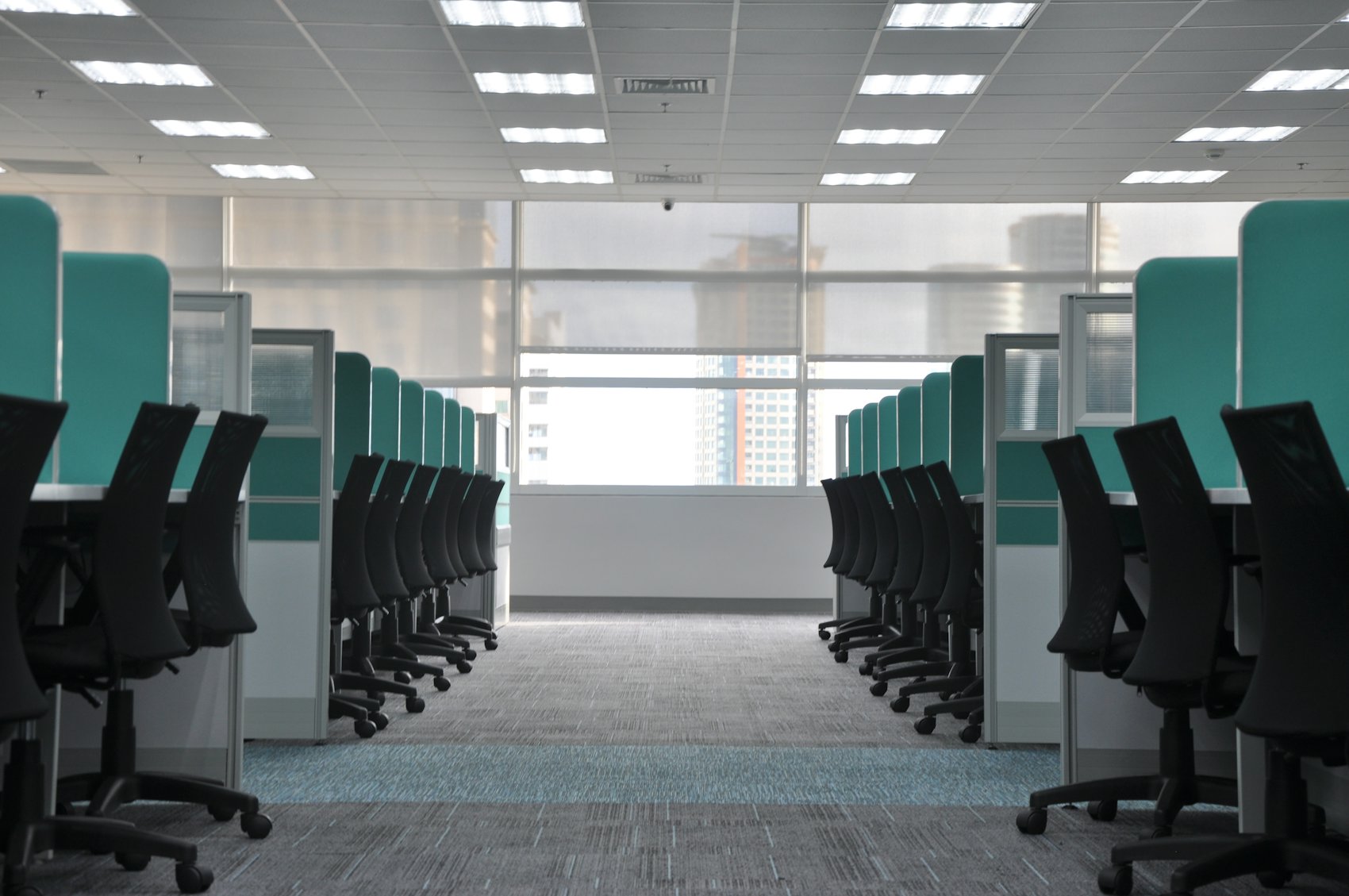
Productivity problems in an office are often layout problems. People get interrupted because the only quiet place is a conference room that is always booked. Calls bleed into the next desk. Chairs do not adjust, so by mid-afternoon everyone is shifting in their seat. None of these are fixed by working harder. They are fixed by planning the space.
Here is how to think through a productive office layout, what to prioritize and how pre-owned furniture helps you afford a better plan.
Start with zones, not desks
Before choosing furniture, list the kinds of work your team actually does. Most offices need four zones.
- Focus zone: individual workstations for heads-down work. This is where most hours are spent, so it gets the most square footage.
- Collaboration zone: conference rooms, huddle tables and project areas where talking is expected.
- Social zone: break room and casual seating, away from the focus area.
- Support zone: printers, storage, mail and supplies, placed where foot traffic will not cut through workstations.
The key move is separation. Put the kitchen and the busiest meeting rooms on the far side of the floor from the teams that need quiet. Place printers and supply storage near circulation paths, not in the middle of a row of desks.
Choose the right level of privacy
Open offices are cheaper to furnish, but too little privacy costs focus. Panel height is the simplest way to tune privacy for each team.
| Panel height | What it does | Best for |
|---|---|---|
| Low, about 42 in | Divides desk surfaces, keeps sight lines open | Teams that collaborate constantly |
| Mid, about 53 in | Blocks seated sight lines, still feels open standing | Most general office work |
| Tall, 65 in and up | Blocks sight lines and reduces noise the most | Phone-heavy roles, finance, HR, focused work |
You can mix heights on one floor. A common approach is lower panels along the window side for light and taller panels near noisy areas. Fabric-covered panels absorb more sound than glass or hard surfaces, so choose fabric where noise is a concern.
Get ergonomics right at every seat
An uncomfortable setup drains focus slowly all day. The basics are simple, and they apply whether furniture is new or pre-owned.
Ergonomic setup checklist
- Seat height: feet flat on the floor, thighs roughly level.
- Seat depth: two to three finger widths between the seat edge and the back of the knees.
- Lumbar support: the curve of the backrest meets the lower back.
- Armrests: low enough that shoulders stay relaxed.
- Keyboard: at about elbow height with forearms close to parallel to the floor.
- Monitor: about an arm's length away, top of the screen near eye level.
- Surface: enough depth for the monitor distance and enough width for documents.
The chair does most of the work. Pre-owned task chairs from manufacturers such as Herman Miller, Steelcase, Haworth and Humanscale were engineered for full-day use. When you buy used, test or ask about every adjustment: height, tilt, tilt lock, seat depth and arms. Browse pre-owned office chairs to compare models.
Plan circulation and support
- Keep accessible routes at least 36 inches clear, and make main aisles wider so two people can pass. Check your local code and building requirements.
- Leave enough room behind chairs so people are not bumped when colleagues walk by.
- Plan power and data early. Workstation furniture prices exclude electrical, so involve your electrician before the layout is final.
- Put storage at each workstation or in a shared bank so desks stay clear.
- Use natural light for workstations where you can, and keep meeting rooms toward the interior.
Stretch the budget with pre-owned furniture
A better layout often means more furniture: taller panels for some teams, a few extra huddle tables, better chairs. Pre-owned furniture is how many offices pay for those upgrades. Here is what a 6 by 6 foot workstation costs, furniture only.
| Tier | Price per 6x6 station | Lead time |
|---|---|---|
| Liquidation-grade | $615 | As little as 72 hours in stock |
| Remanufactured | $1,245 | Usually 7 to 14 days |
| New | $1,920 | 4 to 6 weeks |
Average market rate Prices subject to availability and project pricing.
Prices exclude electrical, delivery and professional installation. Installation is $95 per workstation with a $495 minimum. Volume pricing takes 5% off at 20 or more stations, 8% at 50 or more and 12% at 100 or more. For a 40-station floor, choosing liquidation-grade over new is a difference of $1,305 per station before the volume discount, money that can go toward chairs, meeting space or acoustics.
Pre-owned pieces are graded A (like new), B (very good) or C (good). Office Station is an independent reseller, not an authorized dealer, and manufacturer warranties generally do not transfer to pre-owned furniture.
Put the plan on paper
Space planning is free. Send a floor plan or measurements, headcount by team and the kind of work each team does, and we will suggest workstation sizes, panel heights and a layout. In Greater Phoenix, delivery is zone priced at $195 central and $295 metro, with pages for areas such as Phoenix and Scottsdale. Freight elsewhere is quoted per project. You can also read our guide to a conference room on a budget for the collaboration side of the plan.
Frequently asked questions
What is the most productive office layout?
There is no single best layout, but the most productive offices mix zones. Heads-down work happens in workstations with enough privacy to limit visual and noise distractions, while collaboration happens in separate meeting and huddle spaces. Keeping loud and quiet activities apart matters more than any one furniture style.
What panel height should cubicles be?
Low panels around 42 inches keep an open feel and work for teams that talk often. Mid-height panels around 53 inches block most seated sight lines. Tall panels of 65 inches or more give the most privacy and suit focused work, calls and confidential tasks.
Is used office furniture ergonomic enough?
Quality pre-owned task chairs and workstations from major manufacturers were designed for ergonomic use and often retain their adjustments. Check that seat height, tilt, seat depth and armrests all move and lock properly. Keep in mind that manufacturer warranties generally do not transfer to pre-owned furniture.
How much does it cost to set up workstations?
A 6 by 6 foot workstation, furniture only, runs $615 liquidation-grade, $1,245 remanufactured or $1,920 new. Those prices exclude electrical, delivery and professional installation. Installation is $95 per workstation with a $495 minimum, and volume pricing starts at 5% off for 20 or more stations.
How quickly can I get furniture for a new layout?
Liquidation-grade furniture can be available in as little as 72 hours when it is in stock. Remanufactured usually takes 7 to 14 days, and new typically takes 4 to 6 weeks. Planning early lets you choose the tier based on budget rather than deadline.
Average market rate Prices subject to availability and project pricing.