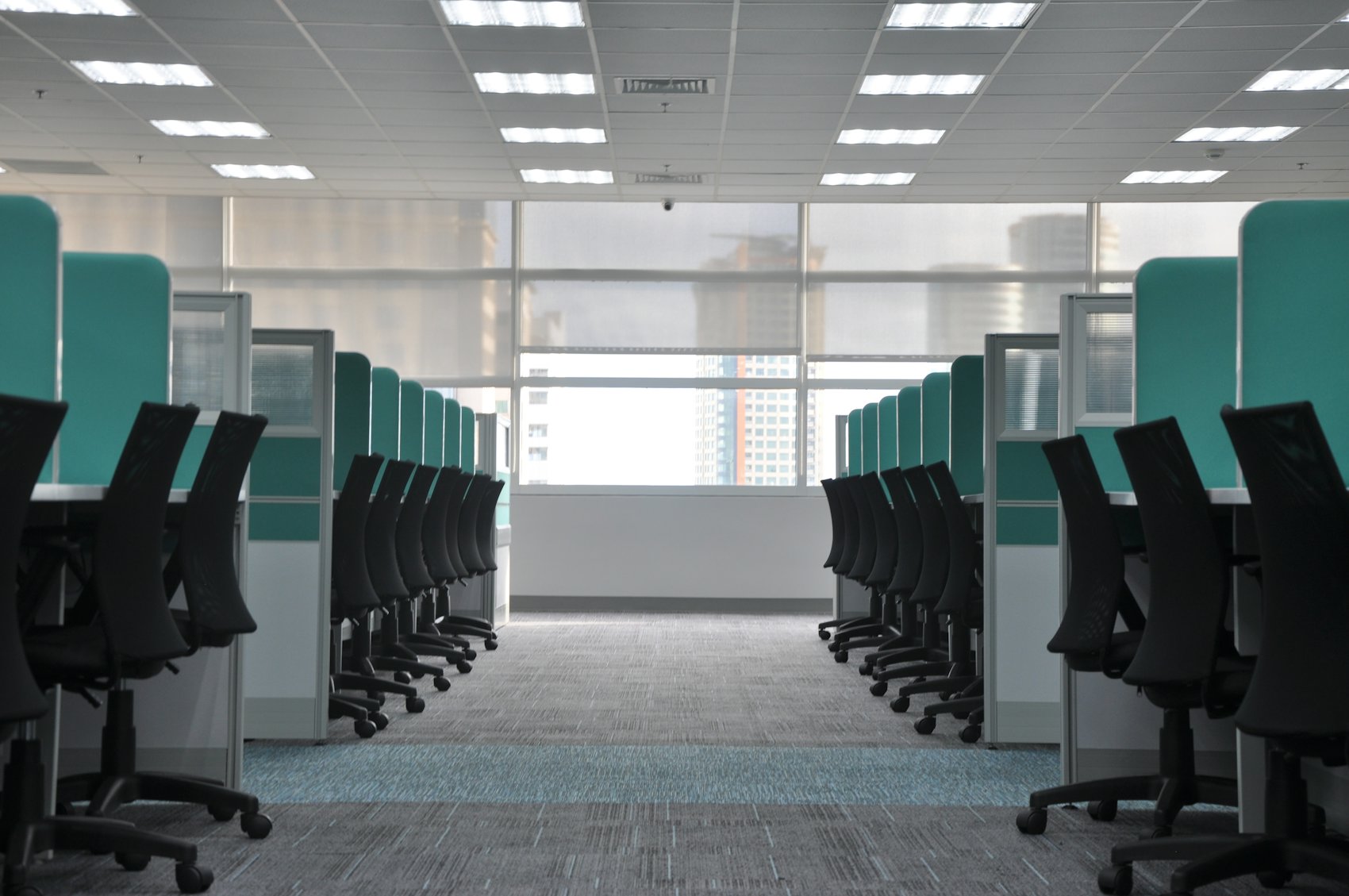
A call center closure moves faster than almost any other kind of office shutdown. The decision often comes with a hard date: a contract ends, a client moves work offshore, operations consolidate into a hub, or a lease runs out. Hundreds of agents may be gone in weeks, and the space behind them is filled with identical workstations, chairs, headsets, and computers.
That density is good news. Matched runs of furniture are exactly what buyers want, so a call center can recover more value per square foot than a typical office. It also raises the stakes. Customer data sits on every desktop, recorded calls sit on servers, and a tall-panel system can take far longer to remove than anyone planned.
This guide is written for operations leaders, facilities managers, finance teams, and brokers responsible for closing a contact center on time and on budget.
In this guide:
- Why call centers liquidate differently
- What sells and what does not
- Tall-panel systems and benching
- Headsets, IT, and e-waste
- Building a fast schedule
- Multi-site closures
- Call center closure checklist
Why call centers liquidate differently
A typical corporate office is a mix: private offices, a few conference rooms, some workstations, and furniture bought over many years. A call center is usually the opposite. Most of the floor is one workstation design, often installed in a single purchase, with a matching chair at every seat.
That uniformity changes the liquidation in four ways:
- Matched runs resell as a set. A buyer furnishing a new floor wants 50 or 200 identical stations, not a patchwork. A uniform run is worth more than the same number of mismatched pieces.
- Disassembly is repetitive. Crews can work efficiently when every station comes apart the same way, which keeps labor cost per seat down.
- Parts tracking matters. Systems furniture is only valuable if it is complete. Missing connectors, brackets, or worksurface supports can turn a sellable run into scrap.
- Electronics volume is high. Every seat has a computer, monitors, a headset, and often a phone, so the IT and e-waste workstream is large.
What sells and what does not
Your recovery depends on the specific furniture, not the fact that it came from a call center. The table below gives a general picture of how common call center assets behave in the resale market. Every space still needs to be seen in person.
| Asset | Resale outlook | What moves the number |
|---|---|---|
| Agent task chairs in matched quantities | Often strong for name-brand ergonomic models | Brand, model, fabric condition, working mechanisms |
| Current systems workstations and benching | Moderate to strong for complete runs | Manufacturer, panel height, finish, completeness |
| Older or discontinued tall-panel cubicles | Weak to none | Parts availability, fabric wear, dated finishes |
| Height-adjustable desks | Often moderate to strong | Working motors and controls, frame brand |
| Supervisor and team lead stations | Moderate | Whether they match the agent run |
| Training room tables and chairs | Moderate | Flip-top or nesting designs, quantity |
| Break room tables, chairs, and lockers | Weak to moderate | Quantity and condition |
| Headsets and phones | Varies; often low per unit | Model, compatibility, complete sets |
The number that matters is net recovery: resale value minus the cost to disassemble, move, and dispose of what does not sell. Office Station gives you that figure as a single written net offer. For a first look at how your seat count might land, try the liquidation estimator, and see the liquidation cost guide for the full math.
Tall-panel systems and benching
Call centers commonly use one of two layouts: tall-panel cubicles that reduce noise between agents, or low benching with short screens that packs more seats into the floor. Both affect removal cost and resale.
Tall-panel systems
Tall panels are heavy, built from many components, and often carry integrated electrical and data raceways. That means:
- Power has to be safely disconnected before disassembly. Base-feed and ceiling-feed power connections need a licensed electrician where required.
- Cabling inside panels has to come out, and your lease may require removing cabling in ceilings and floors too.
- Disassembly takes longer per seat than benching, and tracking the connectors and hardware for each run is essential to resale.
- Resale depends heavily on age. Newer tall-panel systems from major manufacturers can sell. Older systems with worn fabric often do not, and become a removal cost.
Benching and low screens
Benching comes apart faster and ships more compactly. Current benching and height-adjustable frames often resell well because they suit modern open plans. Screens and dividers should stay with their frames so the sets remain complete.
If you are unsure what you have, our used vs remanufactured vs new cubicles guide explains how the market treats different systems.
Headsets, IT, and e-waste
The IT workstream in a call center is where compliance risk lives. Contact centers handle customer names, account numbers, and sometimes payment card data or health information, depending on the client. That information can persist on devices long after the last call.
Know what holds data
- Agent desktops, thin clients with local storage, and laptops.
- Servers, including call recording, workforce management, and quality monitoring systems.
- Voicemail and phone systems, including on-premises PBX equipment.
- Network equipment such as firewalls, switches, and wireless controllers that store configuration data.
- Copiers, multifunction printers, and scanners with internal drives.
- Security DVRs and access control panels.
Headsets
Headsets usually do not store data, but they create a large, messy inventory. Count headsets, wireless bases, amplifiers, and USB adapters against your asset records. Separate company-owned headsets from any provided by a client or telecom vendor, redeploy what the business can use elsewhere, and send the rest for resale or electronics recycling. Hygiene concerns limit resale of used ear cushions, so replacement parts may be needed for any units that sell.
Documented destruction
- Confirm record retention requirements with compliance and legal before any device is wiped. Client contracts often specify how data must be returned or destroyed.
- Collect every data-bearing device before the furniture crew arrives, logged by serial number or asset tag.
- Require chain of custody from pickup to final processing.
- Require certificates of data destruction listing serial numbers, method, date, and responsible party, and reconcile them against your inventory.
Office Station handles general e-waste with certificates of data destruction, so furniture removal and electronics disposition run on one schedule under one set of records.
Schedule a call center walkthrough
Building a fast schedule
Call center closures rarely come with generous timelines. Here is how the work typically stacks when you are moving quickly.
| Stage | What happens | How to speed it up |
|---|---|---|
| Announcement | Inventory frozen, assets tagged stay or go | Lock storage rooms and restrict removals that day |
| Walkthrough | Itemized inventory and building access review | Book it immediately, before the last shift |
| Offer | Written net offer for the whole site | Share seat counts, floor plans, and furniture specs up front |
| Building approvals | COIs, dock and freight elevator reservations | Request the building's move-out rules on day one |
| IT collection | Devices logged and removed under chain of custody | Run it the day after the last shift |
| Furniture removal | Disassembly, loading, and cleanout | Nights and weekends crews; multiple docks where allowed |
| Closeout | Cabling, repairs, walkthrough, documents | Coordinate cabling removal with panel teardown |
Office Station typically walks sites within 48 hours in Greater Phoenix and within 2 to 3 business days in other markets, sends written offers within 5 business days, and runs nights and weekends crews. We handle COIs and coordinate freight elevators and docks with property management. For a date-by-date plan, see the lease-end liquidation timeline.
If the call center is in a building with active tenants, expect restricted hours for heavy removal. After-hours work keeps the schedule intact without disrupting neighbors.
Multi-site closures
Contact center consolidations often close several sites at once, sometimes in different states. Running each one with a different vendor creates inconsistent inventories, pricing, and documentation, which makes it hard for finance to reconcile the program.
With one vendor across sites, you get:
- One inventory format so asset counts and conditions compare cleanly.
- One offer structure so net recovery or net cost is reported the same way everywhere.
- One set of closeout documents: settlement statements, certificates of data destruction, and diversion summaries.
- Coordinated timing so crews move from site to site in a planned sequence.
- Redeployment options when a surviving hub needs furniture from a closing site. Our corporate relocation service can move matched runs to the location that stays open.
Office Station serves Phoenix, Tucson, Flagstaff, Las Vegas, Reno, San Diego, Orange County, Northern California, Denver, Salt Lake City, and Albuquerque. Brokers and consultants managing portfolio exits can work with us through our partner program.
Call center closure checklist
Planning
- Confirm the surrender date, holdover terms, and restoration requirements in the lease.
- Freeze furniture and equipment inventory on announcement day.
- Identify what relocates to another site, what is leased, and what is client-owned.
- Review client contracts for data return and destruction requirements.
- Request walkthroughs and written offers.
Building
- Get the building's move-out rules and COI requirements.
- Reserve freight elevators and docks, with a buffer day.
- Confirm permitted working hours for removal.
IT and data
- Log every computer, server, phone, headset, and network device.
- Shut down telecom circuits, contact center platforms, and recording systems in the correct order.
- Return leased copiers and telecom equipment to their owners.
- Collect certificates of data destruction and reconcile them against the inventory.
Furniture and space
- Disconnect panel power safely before disassembly.
- Remove workstations, chairs, training rooms, break rooms, and lockers.
- Remove cabling as the lease requires.
- Patch walls, replace ceiling tiles, and clear debris.
Closeout
- Complete the landlord walkthrough and punch list.
- File the settlement statement, certificates, and diversion summary.
- Return keys and badges and get written acceptance of the premises.
The office decommissioning checklist covers the full space-return scope in more detail, and the office furniture liquidation playbook covers the furniture side step by step. If you are weighing selling against auctioning or donating, read liquidation vs auction vs donation.
When you are ready, Office Station can walk the site, hand you an itemized inventory and written net offer, and clear the floor on your schedule through our office furniture liquidation and office decommissioning services.
Get a call center liquidation offer
Frequently asked questions
What is call center liquidation?
Call center liquidation is the process of selling, removing, and disposing of a contact center's furniture, equipment, and electronics when the site closes, downsizes, or consolidates. It typically covers agent workstations, chairs, supervisor stations, break rooms, headsets, phones, computers, and network equipment, along with data destruction and final cleanout.
Does call center furniture have resale value?
Often, yes. Call centers tend to have large quantities of identical workstations and task chairs bought at the same time, and buyers value matched runs because they can furnish an entire floor with one consistent look. Value depends on manufacturer, age, condition, and whether the systems are complete with all panels, worksurfaces, and components.
How long does it take to remove call center furniture?
It depends on seat count, panel height, building access, and whether the work runs nights and weekends. A few hundred seats with dock and freight elevator access can often be cleared in days rather than weeks once the schedule is set. Complex tall-panel systems with integrated power and data take longer than low benching.
What should I do with call center headsets?
Collect and count them against your asset list, separate any wireless base units and USB adapters, and decide whether to redeploy, resell, or recycle. Headsets generally do not store data, but connected softphones, computers, and phone systems can. Recycle what does not resell through an electronics recycler rather than the trash.
Do I need data destruction when closing a call center?
Yes, for any data-bearing device. Call center computers, servers, call recording systems, voicemail platforms, and copiers may hold customer information, payment data, or recorded calls. Require a documented chain of custody and certificates of data destruction that list serial numbers, and confirm any retention obligations with your compliance team first.
Can one vendor handle closing multiple call centers?
Yes, and it usually simplifies the project. A single vendor can apply one inventory format, one pricing approach, and one set of closeout documents across every site, which makes reporting to finance and leadership far easier. Office Station serves markets across the Southwest and can coordinate schedules across locations.